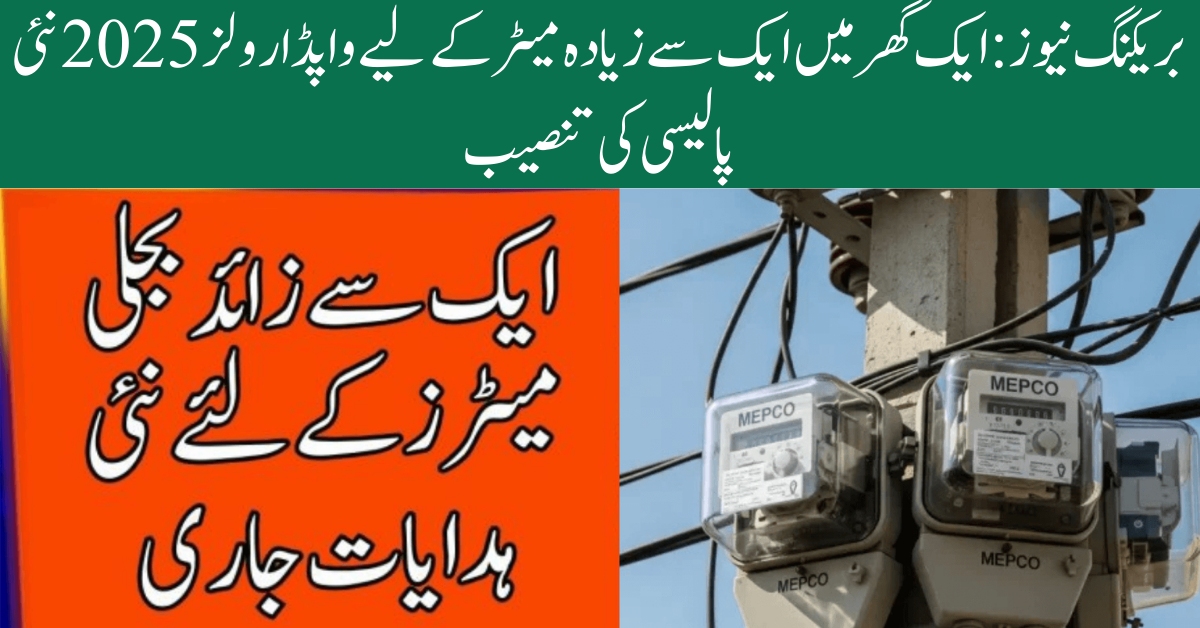
Big news is shaking up the electricity sector in Pakistan! The Water and Power Development Authority (WAPDA) has just announced a new policy for installing multiple meters at one home. The 2025 rules are set to transform how families, landlords, and businesses manage their electricity needs.
If you’ve ever struggled with high bills, tenant disputes, or expanding your home, this update could be a game-changer. Let’s break down what’s new, what it means for you, and how you can benefit from these changes.
Quick Summary Table: Breaking News at a Glance
| Feature/Rule | Old Policy (Before 2025) | New Policy (2025 Onwards) |
| Number of meters per home | Usually 1, rarely 2 | Up to 4 (with conditions) |
| Eligibility | Strict, limited to joint families | Broader, includes tenants and businesses |
| Application process | Paperwork-heavy | Streamlined, online options available |
| Security deposit | High | Reduced for additional meters |
| Meter separation for tenants | Not allowed | Now permitted with documentation |
| Processing time | 2-3 months | 2-4 weeks |
| Inspection frequency | Annual | Bi-annual for multiple meters |
Why This Policy Matters: Real-Life Impact
Empowering Homeowners and Landlords
For years, families living under one roof—especially in joint family systems—have faced headaches over electricity bills. Landlords renting out portions of their homes often struggled to split costs fairly. The Breaking News: New Policy for Installing Multiple Meters at One Home WAPDA Rules 2025 is designed to solve these problems.
Key Benefits:
- Fair Billing: Each family or tenant pays only for what they use.
- Reduced Disputes: No more arguments over shared bills.
- Business Growth: Home-based businesses can now have separate meters, making accounting easier.
Real-Life Example
Take the case of Mr. Ahmed in Lahore. He rents out two floors of his house. Under the old rules, he had to split the bill manually, leading to frequent disputes. With the new policy, each floor can have its own meter, making life simpler for everyone.
What’s New in the 2025 WAPDA Rules?
Expanded Eligibility Criteria
Who Can Apply for Multiple Meters?
- Joint families living in the same house but operating as separate households.
- Landlords with multiple tenants.
- Home-based businesses needing separate billing.
- Extended families with independent living arrangements.
Required Documentation
- Proof of residence (CNIC, utility bill)
- Ownership or tenancy documents
- Floor plan or property map
- NOC from local authorities (if required)
Streamlined Application Process
Step-by-Step Guide
- Online Application: Visit the WAPDA portal and fill out the multiple meter request form.
- Document Upload: Attach scanned copies of required documents.
- Site Inspection: WAPDA team visits to verify the setup.
- Approval & Installation: If all checks out, meters are installed within 2-4 weeks.
Pro Tips for a Smooth Process
- Double-check your documents before submission.
- Mark separate entrances or living spaces clearly.
- Follow up regularly via the WAPDA helpline.
Financial Impact: Costs, Deposits, and Savings
What Will It Cost?
| Item | Old Cost (PKR) | New Cost (PKR) |
| Security deposit (per meter) | 10,000 | 7,000 |
| Processing fee | 2,000 | 1,500 |
| Installation charges | 5,000 | 4,000 |
Good news: The new policy reduces upfront costs, making it easier for more people to apply.
Long-Term Savings
- Accurate billing means you only pay for what you use.
- No more subsidizing your tenants’ or relatives’ high usage.
- Potential for lower tariffs if you qualify for domestic rates on each meter.
Compliance and Inspections: What to Expect
WAPDA’s New Inspection Regime
- Bi-annual checks for homes with multiple meters.
- Random audits to prevent misuse or illegal connections.
- Heavy fines for violations, including meter tampering or false documentation.
Stay compliant to avoid penalties and ensure uninterrupted service.
Personal Background or Net Worth: Who’s Behind the Policy?
While this policy is a government initiative, it’s worth noting that WAPDA’s leadership has a track record of modernization. Chairman Engr. Lt. Gen. Sajjad Ghani (Retd) has spearheaded several reforms, focusing on transparency and customer service.
WAPDA’s annual budget for 2025 is over PKR 200 billion, with a significant portion allocated to infrastructure upgrades and digital transformation. This new policy is part of a broader push to make electricity access fairer and more efficient for all Pakistanis.
Emotional Reactions: Public Sentiment
The response to the Breaking News: New Policy for Installing Multiple Meters at One Home WAPDA Rules 2025 has been overwhelmingly positive. Social media is buzzing with stories of families finally getting relief from unfair billing. However, some critics worry about potential misuse or increased bureaucracy.
Powerful words from users:
- “Finally, justice for tenants!”
- “No more fighting over bills—thank you, WAPDA!”
- “Hope this doesn’t lead to more red tape.”
FAQs: Your Questions Answered
Can I install more than two meters at my home?
Yes, under the new rules, you can install up to four meters per residential property, provided you meet the eligibility criteria.
How long does the process take?
The new streamlined process takes about 2-4 weeks from application to installation.
What documents do I need?
You’ll need proof of residence, ownership or tenancy documents, and a property map or floor plan.
Will my electricity bill go up?
Not necessarily. In fact, you may save money by only paying for your actual usage, especially if you have tenants or a home business.
What if I misuse the policy?
WAPDA has strict penalties for misuse, including heavy fines and possible disconnection.
Final Thoughts: A Step Toward Fairness and Transparency
The Breaking News: New Policy for Installing Multiple Meters at One Home WAPDA Rules 2025 is a bold step toward fairness, transparency, and convenience for millions of Pakistanis. Whether you’re a homeowner, landlord, or tenant, these changes could make your life easier—and your bills more manageable.